The Future of Backup May Be Distributed: Introducing the Concept Behind Weldon CloudFabric™
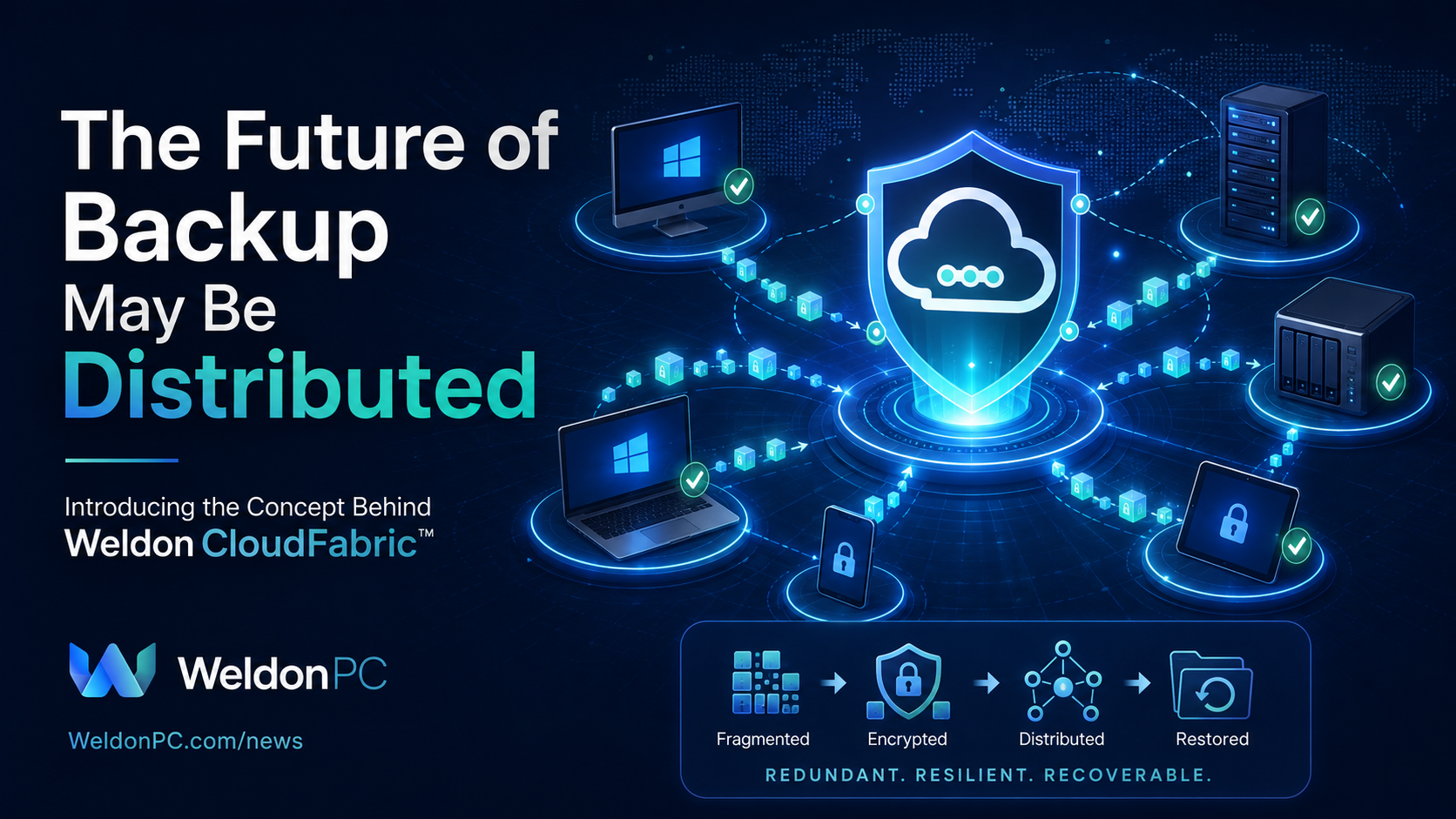
For decades, computer backup has followed the same basic pattern: data leaves one computer and is copied to another storage location.
That second location may be an external drive, a local server, a network-attached storage device, or a cloud provider. The technology has improved tremendously, but the underlying architecture is still usually based on the idea that a customer's data is stored in a relatively small number of centralized locations.
At WeldonPC, we have been exploring a different question:
What if backup became stronger as the customer network became larger?
That idea has led us to begin developing the concept behind Weldon CloudFabric™, a next-generation distributed backup, disaster recovery, and cloud-storage platform designed to combine the convenience of cloud storage with the resilience of a peer-powered storage network.
CloudFabric is currently a concept under development, not a commercially available service. But the architecture represents an important direction we believe could reshape how residential and business customers think about data protection.
The Problem With Traditional Backup
Traditional cloud backup works well, but it usually creates several infrastructure challenges.
As more customers are added, the provider must continuously add more storage, bandwidth, servers, and data-center capacity.
In a traditional model:
More customers = more data = more infrastructure cost.
There are also practical concerns surrounding disaster recovery.
If a backup exists in only one off-site location, restoration depends on that location being reachable and capable of delivering the data quickly enough.
For small file restores, this is rarely a major issue.
For a multi-terabyte server, ransomware recovery, or complete business disaster, restore speed becomes much more important.
CloudFabric approaches the problem differently.
A Backup Network That Grows With Its Customers
The fundamental idea is simple.
Instead of storing every customer's backup as a complete file on a single remote server, CloudFabric would first encrypt the customer's data and break it into protected fragments.
Those fragments could then be distributed across multiple independent storage locations.
A simplified example might look like this:
Computer A creates a backup.
Before that backup leaves the computer, CloudFabric:
- Identifies and deduplicates the data.
- Encrypts it.
- Breaks it into smaller pieces.
- Creates additional recovery fragments.
- Distributes those fragments among multiple storage nodes.
Those storage nodes could include:
- WeldonPC-owned servers
- Data-center systems
- Business servers
- Customer backup appliances
- Desktop computers
- Workstations
- Linux systems
- Mac computers
- Selected network-attached storage systems
Mobile devices such as Android phones, iPhones, and tablets could participate primarily as backup and file-access clients, while more dependable desktop and server systems would provide the majority of durable storage capacity.
The important part is that no ordinary participating computer would need to contain a complete readable copy of another customer's backup.
Encryption Happens Before Distribution
Security has to be fundamental to a system like this.
CloudFabric would be designed so that data is encrypted before it is distributed.
A participating storage computer would receive something resembling an encrypted fragment with a meaningless identifier.
It should not know:
- The customer's name
- The original filename
- The original folder structure
- The type of document
- The contents of the file
- The encryption key
A storage node might contain thousands of encrypted fragments while having no practical way to determine what those fragments represent.
The ability to reconstruct the data would remain with the authorized customer and the CloudFabric recovery system.
Redundancy Is More Important Than Replication
One way to build a distributed backup network would simply be to make three complete copies of every file.
That works, but it wastes a tremendous amount of storage.
CloudFabric would instead be designed around a technology known as erasure coding.
Erasure coding allows information to be divided into multiple fragments while creating additional recovery fragments.
As a conceptual example, a backup might be transformed into 16 fragments while only 10 are required to reconstruct the original data.
That means several storage nodes could disappear without losing the backup.
If one or two computers shut down overnight, the backup remains available.
If a hard drive fails, the backup remains available.
If a customer replaces a computer, the backup remains available.
If an Internet provider experiences an outage, the backup can potentially remain available from completely different locations.
The system would continuously monitor how many verified fragments remain and automatically create replacements whenever redundancy begins to fall.
What Happens When Computers Go Offline?
This is one of the most important questions in any distributed-storage system.
The answer is that CloudFabric should expect computers to disappear.
Residential computers shut down.
Laptops travel.
Businesses lose Internet connectivity.
Hard drives fail.
Computers are replaced.
CloudFabric would therefore never assume that every storage node is permanently available.
Each storage node would maintain a reliability history based on factors such as:
- Uptime
- Network availability
- Disk health
- Integrity checks
- Connection speed
- Historical reliability
- Geographic location
- Network provider
An always-on server in a data center would receive a much higher reliability rating than a laptop that is online only a few hours per day.
The storage system could then place data intelligently.
A critical recovery fragment would be more likely to reside on an always-on server than on an occasionally connected laptop.
Automatic Repair
Imagine that CloudFabric created 16 fragments for a protected piece of data and determined that 10 were necessary for recovery.
If 15 remain available, nothing important needs to happen.
If availability falls to 13 or 14, the system may begin planning repair.
If only 11 or 12 remain, repair becomes urgent.
CloudFabric could retrieve enough healthy fragments to reconstruct the missing ones and distribute replacement fragments to new storage nodes.
The process would happen automatically.
That means redundancy is not simply created once and forgotten.
It is continually maintained.
WeldonPC Servers Would Remain the Backbone
A distributed architecture does not mean WeldonPC servers disappear.
In fact, they become even more important.
During the early stages of the platform, WeldonPC-owned infrastructure would provide the overwhelming majority of storage and reliability.
As more customers joined the network and opted to contribute available storage, more encrypted fragments could gradually move into the distributed fabric.
The growth curve could evolve over time from a network heavily dependent on WeldonPC-owned infrastructure toward one that uses a larger percentage of distributed storage, while WeldonPC systems remain the anchors, repair reserve, control layer, and emergency recovery source.
The exact balance would be determined dynamically by the reliability and capacity of the network.
The Network Gets Stronger as It Grows
This creates an interesting economic and technical effect.
Traditional cloud storage generally works like this:
More customers → more storage demand → more servers must be purchased.
A distributed network could behave differently:
More customers → more storage demand + more potential storage capacity + more geographic diversity + more bandwidth sources.
Customers could optionally allocate a controlled amount of unused storage to the network.
A desktop might contribute a few hundred gigabytes.
A business workstation might contribute more.
A server might contribute several terabytes.
Participation would always need to be optional, clearly disclosed, controlled, and reversible.
Customers who do not wish to contribute storage could still use the service normally.
Disaster Recovery Could Become Faster
Distributed storage may also provide a significant restore advantage.
Traditional cloud restoration generally downloads data from one provider or one data-center endpoint.
CloudFabric could potentially download different fragments of the backup from several sources simultaneously.
Instead of:
One server → customer
the recovery might resemble:
Weldon Server A → customer
Weldon Server B → customer
Business Node A → customer
Business Node B → customer
Local Appliance → customer
All simultaneously.
The customer's Internet connection would still determine the maximum possible download speed, but the network could potentially make much better use of that connection.
Local Recovery Could Be Even Faster
For business customers, we envision combining the distributed network with a local recovery appliance.
That creates two forms of protection.
If someone accidentally deletes a file, it could be restored directly across the local network.
If an entire computer fails, the recovery image could come from the local appliance at LAN speed.
If the building is destroyed, stolen, flooded, or affected by a major ransomware event, the distributed off-site CloudFabric copy becomes the disaster-recovery source.
This hybrid design could provide the speed of local backup with the resilience of distributed off-site storage.
Cloud Storage Could Use the Same Fabric
The architecture does not need to be limited to backup.
The same underlying storage fabric could potentially support a OneDrive-like cloud drive.
Users might see something such as:
Weldon Cloud Drive
- Documents
- Pictures
- Customers
- Projects
- Shared Files
To the customer, it behaves like ordinary cloud storage.
Behind the scenes, however, the data could be encrypted and distributed across the CloudFabric network.
The desktop client could keep frequently used files cached locally for fast access, while less frequently used files could be retrieved from the distributed network when needed.
Windows, macOS, and Linux users could access their files from the desktop.
Android and Apple users could use mobile applications.
Businesses could use browser access, sharing, collaboration, and centralized administration.
Backup and File Synchronization Must Remain Separate
One lesson learned from ransomware is that file synchronization is not the same thing as backup.
If ransomware encrypts a document and a synchronization service immediately synchronizes that encrypted version, the cloud copy can be damaged along with the computer.
CloudFabric would therefore separate live cloud-drive synchronization from immutable backup history.
A customer might have:
Current file: encrypted by ransomware
Previous recovery point: healthy
Yesterday's recovery point: healthy
Last week's recovery point: healthy
Last month's recovery point: healthy
Those protected recovery points should not be modifiable by ordinary synchronization operations.
That gives the customer a known-good point to return to.
Administrators Would See Recoverability, Not Just Backup Status
One of the biggest differences in CloudFabric would be the way administrators view backup health.
Traditional systems often report:
Backup completed successfully.
That is useful, but it does not necessarily answer the most important question:
Can the data actually be restored right now?
CloudFabric would track both.
A business administrator could see:
Latest backup: successful
Off-site protection: healthy
Recovery fragments: verified
Local recovery copy: available
Last test restore: passed
Immutable history: enabled
Encryption recovery: verified
The WeldonPC network operations console would go deeper.
It could display:
- Number of storage nodes
- Number currently online
- Total protected customers
- Protected endpoints
- Raw storage capacity
- Available repair reserve
- Recovery points being repaired
- Critical redundancy events
- Unrecoverable recovery points
- Control-plane status
- Encryption-key service status
- Geographic network events
The goal is to know not only that a backup exists, but whether the system can reconstruct it.
Different Customers Could Have Different Storage Policies
Not every business will be comfortable with encrypted fragments residing on general residential peers.
CloudFabric could therefore support several storage policies.
Shared Fabric
Designed primarily for residential and general commercial use.
Encrypted fragments could reside across WeldonPC infrastructure and verified participating nodes.
Managed Business Fabric
A recoverable portion would remain on WeldonPC infrastructure or approved business nodes, with the wider peer network providing additional redundancy and performance.
Private Fabric
Only explicitly authorized systems could participate.
For example:
- The customer's own offices
- Customer-owned backup appliances
- WeldonPC infrastructure
- Approved data-center systems
No general residential peer storage would be used.
This could be particularly important for organizations with contractual, insurance, privacy, or compliance requirements.
Cross-Platform by Design
The goal would eventually be a single ecosystem supporting:
- Windows PCs
- Windows Servers
- Linux workstations
- Linux servers
- Mac desktops
- MacBooks
- Android devices
- iPhones
- iPads
- NAS appliances
- Virtual servers
- Data-center systems
Every device would not necessarily perform every role.
A Windows server could be a backup source, restore target, storage node, and local cache.
An iPhone might be a backup source, file-access client, and offline cache but would not be counted as a dependable always-on storage node.
Every device can participate in the ecosystem.
Only suitable devices need to provide durable storage.
Security Must Be Built Into the Architecture
A system like CloudFabric cannot simply be a clever storage project.
Security would have to be designed into every layer.
That includes:
- End-to-end encrypted transfer
- Encryption before storage distribution
- Device certificates
- Multi-factor authentication
- Signed software updates
- Integrity verification
- Storage-node reputation
- Automatic quarantine of suspicious nodes
- Immutable audit records
- Protected encryption-key recovery
- Separation of administrator privileges
- Secure device removal
- Ransomware-resistant retention
- Geographic placement policies
- Independent security review
A participating storage computer should never receive enough information to independently reconstruct customer data.
Likewise, a normal network technician should not automatically receive permission to browse customer files simply because that technician can administer storage nodes.
Storage administration and customer-data recovery should be separate security functions.
The Customer Experience Must Remain Simple
The technology behind CloudFabric may be complex.
The customer experience should not be.
A residential user should see something like:
This computer is protected.
Last backup: 12 minutes ago
Latest recovery point: verified
Off-site protection: healthy
Immutable history: enabled
Recovery key: protected
Then three buttons:
Restore Files
Open Cloud Drive
Add Device
The customer should not need to understand encryption algorithms, erasure coding, fragment maps, or peer reputation.
Those systems exist so that the customer does not have to think about them.
Why We Are Exploring This
The concept fits directly into a problem WeldonPC has worked with for years.
Customers do not really want “backup storage.”
They want their information back after something goes wrong.
The difference is important.
A backup is only valuable if it survives the same disaster that destroys the original information.
It must also be secure.
It must be recent.
And it must actually restore.
CloudFabric is an attempt to rethink backup around that outcome.
Instead of asking:
Where is the backup stored?
we want to ask:
How many independent ways do we currently have to recover it?
That may ultimately be a much better measurement of data protection.
Where the Project Goes From Here
The first development stage would not involve customer data.
A laboratory CloudFabric environment could begin with:
- Two WeldonPC anchor servers
- Several Windows storage nodes
- A Linux storage node
- A coordinator
- Synthetic test data
The system would intentionally be subjected to failures.
Storage nodes would be disconnected.
Fragments would be corrupted.
Hard drives would be filled.
Network connections would disappear.
Servers would reboot.
The original copy would eventually be removed.
Then CloudFabric would be required to reconstruct the dataset and produce the exact same cryptographic hash as the original.
Only after repeatedly surviving those tests would the project move into controlled internal deployment and eventually voluntary customer pilots.
Stronger Together
The Internet itself became resilient because it was designed as a network rather than a single path.
CloudFabric applies a similar philosophy to data protection.
Instead of depending entirely on one computer, one building, one server, or one storage provider, encrypted information can potentially be protected across a living network of independent systems.
And unlike traditional infrastructure, the network can gain resources as its customer base grows.
More customers can mean more storage.
More locations.
More bandwidth.
More redundancy.
And ultimately, more ways to recover after something goes wrong.
That is the idea behind Weldon CloudFabric™.
More protection. More resilience. Together.
Weldon CloudFabric™ is currently a research and development concept from WeldonPC. Features, architecture, availability, and product naming described in this article are conceptual and may change prior to any commercial release.